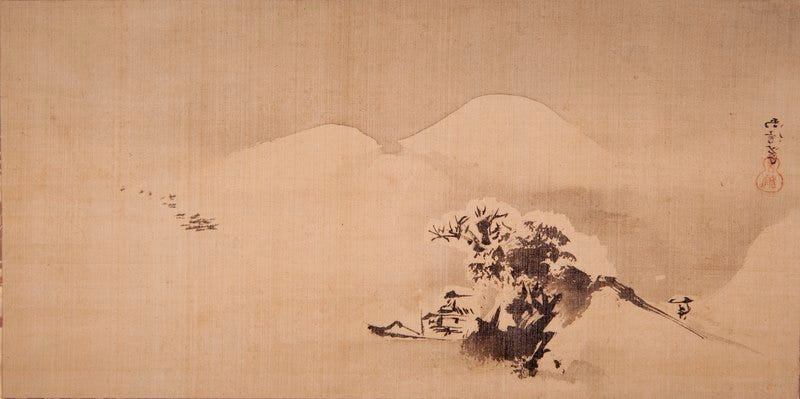
The Snow Man
by Wallace Stevens
One must have a mind of winter To regard the frost and the boughs Of the pine-trees crusted with snow; And have been cold a long time To behold the junipers shagged with ice, The spruces rough in the distant glitter Of the January sun; and not to think Of any misery in the sound of the wind, In the sound of a few leaves, Which is the sound of the land Full of the same wind That is blowing in the same bare place For the listener, who listens in the snow, And, nothing himself, beholds Nothing that is not there and the nothing that is. ══════════════════════════════
“The Snow Man” appeared in Poetry magazine in 1921 and then in the 1923 Harmonium, the first collection of poetry from Wallace Stevens (1879–1955). The book was not a success, and Stevens made sure with his magazine publications that poetry readers saw just how good he was before publishing his next books, especially Ideas of Order (1936) and The Man with the Blue Guitar (1937).
Probably by the time of Stevens’s death, and certainly by the 1970s, poems from Harmonium had entered the standard-anthology canon of English verse — “The Emperor of Ice Cream,” for example, which Poems Ancient and Modern examined this past summer. But there has been no clearer example of Stevens’s ascent in reputation than “The Snow Man,” which is now inescapable, reprinted in nearly any standard collection.
The poem — one long sentence in five three-line stanzas, with hints of rhyme along the way — insists on the difficulty of experiencing a winter landscape and not thinking of a cold misery in the scene. To avoid that thought, the first line tells us, one would have to possess a “mind of winter.” One would have to be, the last lines add, a “listener” who is “nothing himself.”
That ending is ambiguous. Is Stevens saying that we should become impersonal, affectless listeners and so behold the world as it is? Or is he saying that we can never perceive the world as it is, because we would have to cease to exist to do so?
Almost certainly the later, if what are sometimes called Stevens’s “epistemological poems” are a guide. Think of “Thirteen Ways of Looking at a Blackbird,” or “The Idea of Order at Key West” (“there never was a world for her / Except the one she sang and, singing, made”), or the early “Gubbinal” (“That strange flower, the sun, / Is just what you say. / Have it your way”). Or even “The Man with the Blue Guitar,” which puts a thought, parallel to Matthew Arnold’s “Dover Beach,” that the Sea of Faith no longer covers over the meaninglessness of the world and so we must make our own meaning:
The earth, for us, is flat and bare.
There are no shadows. Poetry
Exceeding music must take the place
Of empty heaven and its hymns
(But since the poem continues, “Ourselves in poetry must take their place, / Even in the chattering of your guitar,” Stevens may be being sarcastic about the pretensions of poetry; it’s not clear that he means we can actually create meaning, even of the purely human kind.)

Taken just as philosophical propositions, there isn’t all that much depth in the ideas that “Gosh, maybe things aren’t quite what they seem” and “We can’t ever see what things are when we aren’t seeing them.” We clear these short-distance runs, philosophy-lite, long before we undertake the marathon of the Critique of Pure Reason.
For poets, of course, these propositions may be more fraught with emotion than they are for philosophers, for if poets cannot trust their poetical apprehension of reality, then what are they to trust? It’s powerful for, say, Robert Frost in “The Need of Being Versed in Country Things” to insist that the birds feel none of the sadness we sense when we see the shell of a burned-out house. (“One had to be versed in country things / Not to believe the phoebes wept,” he writes — and note both the Stevens-like “not to believe” and that clever play on “versed.”)
And so, in “The Snow Man,” Stevens insists that the physical world in winter contains none of the misery we sense in it, for the sheer independent reality of things do not depend on us or mirror our perceptions. But the precision with which Stevens describes the snow, ice, trees, and leaves invests with emotional power the poem’s turn to epistemological dismissal. Note, for example, the verb constructions he uses. We get such strong words as crusted and shagged in the first part, and such more abstract and less-visual words as think and the thrice-repeated is in the second part.
And what are we to make of the dual “is” in the conclusion of “Nothing that is not there and the nothing that is”? It’s here that I want to suggest that folding “The Snow Man” into Stevens’s epistemological poetry is a mistake. He has bigger philosophical game in sight in this poem. He’s aiming at something metaphysical.
Language has the verb to be at its core, and so we lack the vocabulary to express the reality of nothingness. (The deep course here would require looking at something like the Pseudo-Dionysius’ Mystical Theology and Nicholas of Cusa’s De docta ignorantia, but the best modern introduction is probably Martin Heidegger’s 1929 lecture, “What Is Metaphysics?”)
Once we get past the ironies of saying that nothing is, however, we have a pair of metaphysical claims at the end of “The Snow Man.” The first is that the (impossible) nothing-himself listener with the mind of winter could behold reality without seeing falsity (“nothing that is not there”), and the second is that this thought-experiment listener could grasp that this reality is the nothing itself, which for philosophers names the sheer principle of negation, without differentiation.
Unlike “Thirteen Ways of Looking at a Blackbird” or “The Idea of Order at Key West,” “The Snow Man” makes a claim about what is, beyond the epistemological perspectivism the poet learned from George Santayana at Harvard. Whether his philosophical attempt is coherent, without a mysticism of the kind that Wallace Stevens rejected, is a question for another day.


Stevens is probably my favorite American poet. As I've always read it, the poem rejects, or at least tries to get the reader to question, the pathetic fallacy and the projection of our responses onto the world outside us; I always think of it together with "Stars at Tallapoosa" ("The body is no body to be seen / But is an eye that studies its black lid") and especially "Esthétique du Mal":
Except for us, Vesuvius might consume
In solid fire the utmost earth and know
No pain (ignoring the cocks that crow us up
To die). This is a part of the sublime
From which we shrink. And yet, except for us,
The total past felt nothing when destroyed.
The inanimate world is simply dead, ruled by natural law. The more animate parts in the snow that the snow man sees live their own lives in their own way severed from our way of feeling. And we experience the world in our own way, projecting that way onto the world as we experience it, and poetry too easily follows that unthinkingly--or rejects our responses to the world and its riches entirely in a Platonic fashion (as in some of his own poems). Hence the last section of "Esthétique du Mal":
The greatest poverty is not to live
In a physical world, to feel that one's desire
Is too difficult to tell from despair. Perhaps,
After death, the non-physical people, in paradise,
Itself non-physical, may, by chance, observe
The green corn gleaming and experience
The minor of what we feel.
Of course, one might say I am simply projecting onto Stevens my own metaphysical and epistemological views. Perhaps.
I always read this poem against the grain. As a Texas transplant to New England who even after 20 plus years still regards snow with childish delight, I find it easy to put on the "mind of winter" and enter into the landscape that others find harsh and sad. Others can have their philosophy and existentialism, I'm here being a snowman and reveling in the starkly beautiful imagery of winter.