

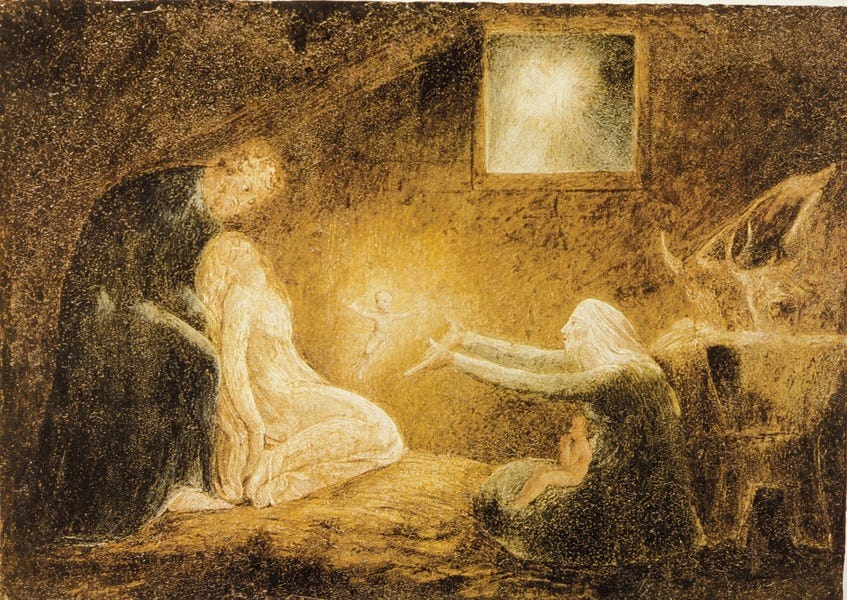

(Here at Poems Ancient and Modern we’re taking a Christmas sabbatical, with reprints of our favorite seasonal poems from last year. Our newer readers might have missed these selections the first time around, while our readers of longer duration may enjoy reading them again.)
The Burning Babe
by Robert Southwell
As I in hoary winter’s night stood shivering in the snow,
Surprised I was with sudden heat which made my heart to glow;
And lifting up a fearful eye to view what fire was near,
A pretty Babe all burning bright did in the air appear;
Who, scorchéd with excessive heat, such floods of tears did shed
As though his floods should quench his flames which with his tears were fed.
‘Alas!’ quoth he, ‘but newly born, in fiery heats I fry,
Yet none approach to warm their hearts or feel my fire but I.
My faultless breast the furnace is, the fuel wounding thorns,
Love is the fire, and sighs the smoke, the ashes shames and scorns;
The fuel Justice layeth on, and Mercy blows the coals,
The metal in this furnace wrought are men’s defiléd souls,
For which, as now on fire I am to work them to their good,
So will I melt into a bath, to wash them in my blood.’
With this he vanished out of sight, and swiftly shrunk away,
And straight I calléd unto mind that it was Christmas day.
═══════════════════════
In his short life, the English priest-poet Robert Southwell (1561–1595) did nothing halfway. Prophetically nicknamed “Father Robert” as a child, at seventeen he walked from Douai, in France, where he had been sent to study, all the way to Rome, in order to beg entry to the Society of Jesus, the religious order founded in 1540 by the Spanish St. Ignatius of Loyola. Ordained a Jesuit priest in 1584, Southwell returned to England two years later, at his own request, as a missionary to recusant Catholics under Elizabeth I.
In the year of his ordination, an act had gone into effect in England, decreeing that any English-born Catholic priest — understood as an agent of the papacy and of Catholic Spain, who had by his own deliberate choice un-Englished himself — if he remained more than forty days in the country, should undergo execution for high treason, by hanging, drawing, and quartering. Southwell stayed six years before his eventual betrayal and capture. Moving from household to household under various disguises, he eluded the Crown’s pursuivants. In 1592, he was run to earth by the Queen’s chief priest hunter, Richard Topcliffe, who was, among other things, the sort of person who didn’t scruple to use rape as a tool for extracting information from women.
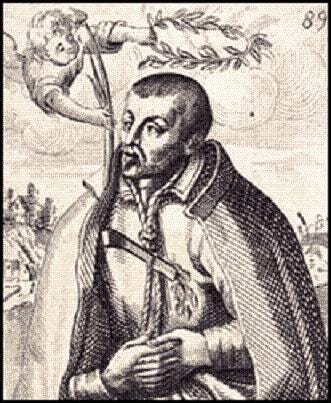

It was by this method, in fact, that Topcliffe had induced a woman, Anne Bellamy, to divulge the identity of the strange young man inexplicably resident in her father’s house. On his arrest, Southwell endured periods of interrogation by Topcliffe personally, then by Privy Council torturers, before spending three years in solitary confinement in the Tower of London. He was executed at Tyburn Gallows, at the junction of two old Roman roads, on February 21, 1595.
Unsurprisingly, given the constant danger under which he performed his priestly ministry, Southwell’s devotional imagery doesn’t exactly suggest comfort. One Christmas poem, “New Heaven, New War,” transforms the tender, helpless babe of the stable, surrounded by angels, into a warrior, come to “rifle Satan’s fold.”
And in Today’s Poem, “The Burning Babe,” the same infant appears in a fiery vision like the burning bush, blazing away yet unconsumed. He seems simultaneously to suffer in a furnace and to be the furnace himself. In heptameter couplets whose insistent lines lick at the page like flames, the poem presents a Christ Child whose love and mercy, as well as his justice, are an immolation. This strange, suffering infant (not the sweetly sleeping babe in the manger) heralds the martyr’s Christmas.


I am reading Joseph Pearce's book _Through Shakespeare's Eyes: Seeing the Catholic Presence in the Plays_, in which he discusses possible links to Southwell's biography and poetry in _Merchant of Venice_. I had known little of Southwell before now, and I appreciate the complementary readings. Given his mission and knowing what almost certainly lay in wait for him, one can understand his seeing even the Child as a "strange, suffering Infant," from whom he could draw courage and perseverance.
I don’t know, 134 years seems quite a long life to me?