


Jubilate Agno (an extract)
by Christopher Smart
For I will consider my Cat Jeoffry.
For he is the servant of the Living God
     duly and daily serving him.
For at the first glance of the glory of God
     in the East he worships in his way.
For this is done by wreathing his body
     seven times round with
     elegant quickness.
For then he leaps up to catch the musk,
     which is the blessing of God
     upon his prayer.
For he rolls upon prank to work it in.
For having done duty and received
     blessing he begins to consider
     himself. . . .
For having consider’d God and himself
     he will consider his neighbour.
For if he meets another cat he will
     kiss her in kindness.
For when he takes his prey he plays
     with it to give it a chance.
For one mouse in seven escapes by
     his dallying.
For when his day’s work is done his
     business more properly begins.
For he keeps the Lord’s watch in the
     night against the adversary.
For he counteracts the powers of darkness
     by his electrical skin and glaring eyes.
For he counteracts the Devil, who is
     death, by brisking about the life.
For in his morning orisons he loves
     the sun and the sun loves him.
For he is of the tribe of Tiger.
For the Cherub Cat is a term of
     the Angel Tiger.
For he has the subtlety and hissing of
     a serpent, which in goodness
     he suppresses.
For he will not do destruction, if he is
     well-fed, neither will he spit
     without provocation.
For he purrs in thankfulness, when God
     tells him he’s a good Cat.
For he is an instrument for the children
     to learn benevolence upon.
For every house is incomplete without
     him and a blessing is lacking
     in the spirit.
For the Lord commanded Moses
     concerning the cats at the departure
     of the Children of Israel from Egypt.
For every family had one cat at least
     in the bag.
For the English Cats are the best
     in Europe. . . .
For he knows that God is his Saviour.
For there is nothing sweeter than
     his peace when at rest.
For there is nothing brisker than his life
     when in motion.
For he is of the Lord’s poor and so indeed
     is he called by benevolence
     perpetually — Poor Jeoffry! poor
     Jeoffry! the rat has bit thy throat.
For I bless the name of the Lord Jesus
     that Jeoffry is better.
For the divine spirit comes about his body
     to sustain it in complete cat.
For his tongue is exceeding pure so that it
     has in purity what it wants in music.
For he is docile and can learn
     certain things.
For he can set up with gravity which is
     patience upon approbation.
For he can fetch and carry, which is
     patience in employment.
For he can jump over a stick which is
     patience upon proof positive.
For he can spraggle upon waggle at
     the word of command.
For he can jump from an eminence into
     his master’s bosom.
For he can catch the cork and
     toss it again.
For he is hated by the hypocrite and
     miser.
For the former is afraid of detection.
For the latter refuses the charge.
For he camels his back to bear the first
     notion of business.
For he is good to think on, if a man would
     express himself neatly.
For he made a great figure in Egypt for
     his signal services.
For he killed the Ichneumon-rat
     very pernicious by land.
For his ears are so acute that they
     sting again.
For from this proceeds the passing
     quickness of his attention.
For by stroking of him I have
     found out electricity.
For I perceived God’s light about him
     both wax and fire.
For the Electrical fire is the spiritual
     substance, which God sends from
     heaven to sustain the bodies both
     of man and beast.
For God has blessed him in the variety of
     his movements.
For, tho he cannot fly, he is an excellent
     clamberer.
For his motions upon the face of the earth
     are more than any other quadruped.
For he can tread to all the measures
     upon the music.
For he can swim for life.
For he can creep.
═══════════════════════
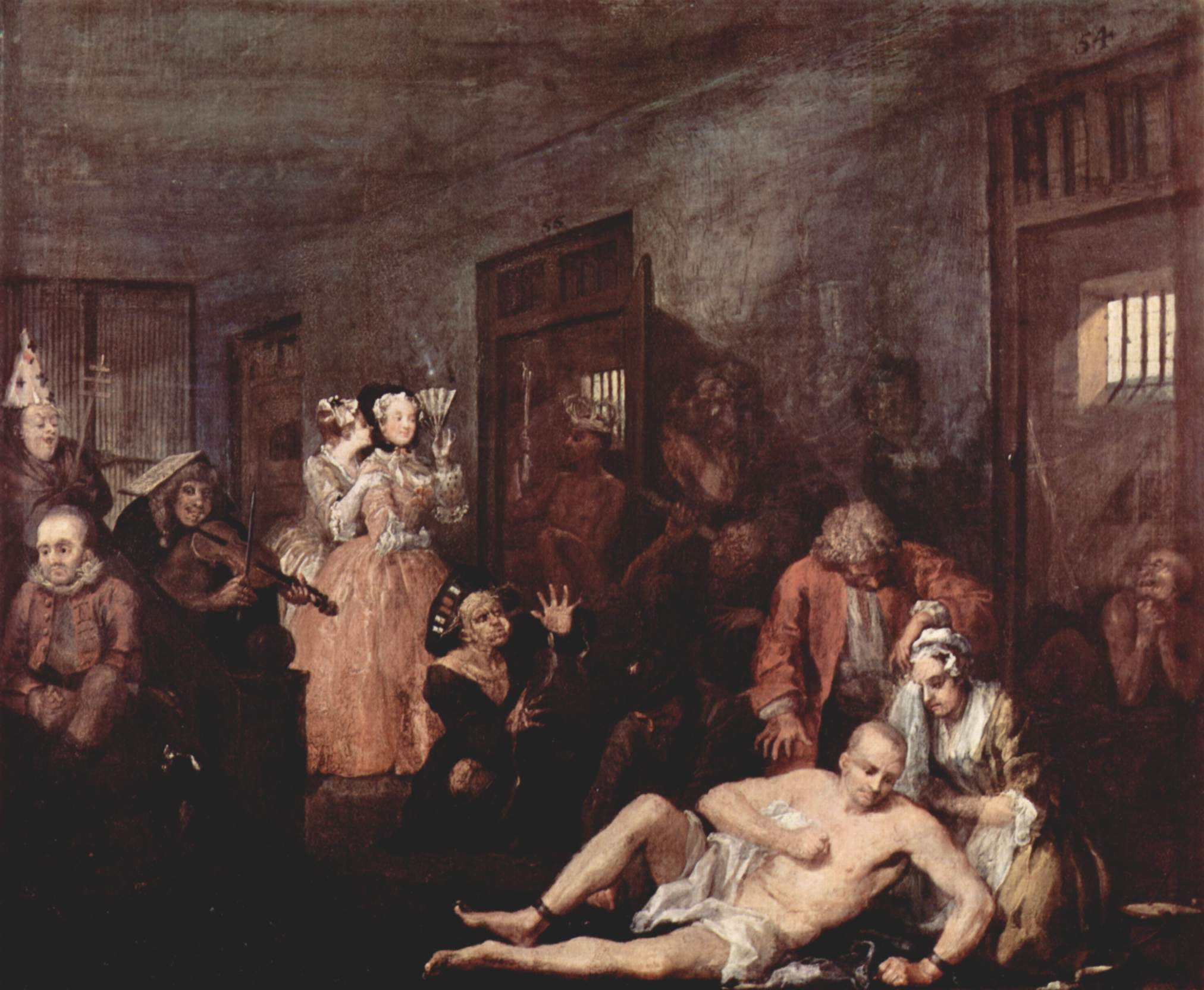
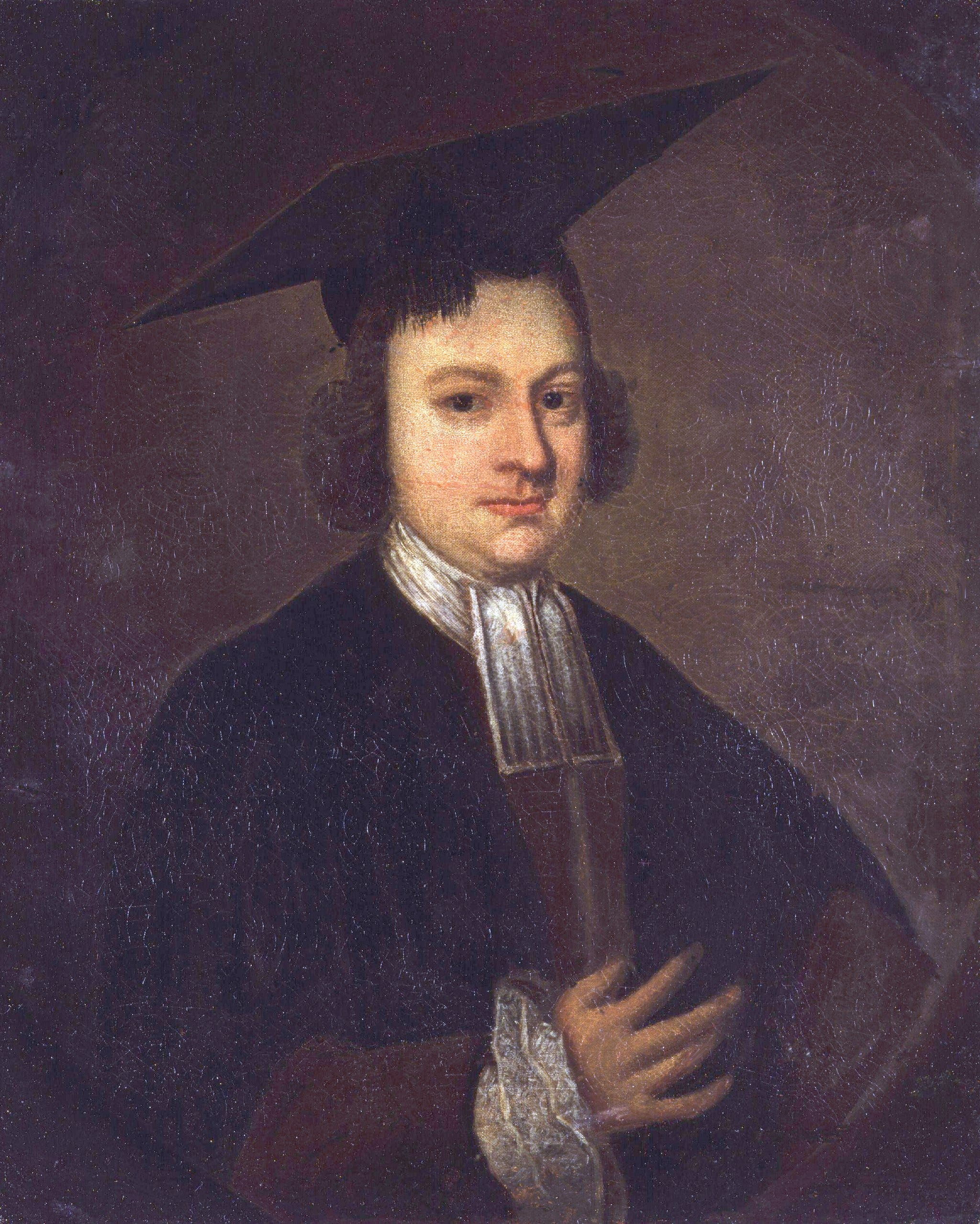
In Boswell’s Life, Samuel Johnson says of poor Christopher Smart (1722–1771), locked in a madhouse: “I did not think he ought to be shut up. His infirmities were not noxious to society. He insisted on people praying with him; and I’d as lief pray with Kit Smart as any one else.”
That line, “I’d as lief pray with Kit Smart as any one else,” has stuck with me since I first encountered it. Christopher Smart was a madman, a genius, and a Christian poet. What is most powerful in him, or, at least has most influenced me, is his mysticism, for it is not a grand thing — not the loss of the self in the absorption into the numinous, not the flight of the alone to the Alone, not the ecstatic transport to the oneness of reality. Smart is instead the model — even in his madness, or maybe especially in his madness — of what I have elsewhere called the mysticism of small things.
This is not pantheism, each object in the world a little God-bit. It cannot be for Smart, because pantheism is irreconcilable with his orthodox Christianity — but even more because pantheism is ultimately a denial of the sharp and vital particularity of things. Christopher Smart sees every living being as entirely itself: distinctive, singular, quirky, special. And in that particularity he sees not God, but God’s grace, God’s plan, and, most of all, God’s creation — a creative power so vast that it can populate the world with real existences that are not God Himself. Smart sees the world as infused with grace, hungry for redemption, and alive with the interaction of creatures and Creator.
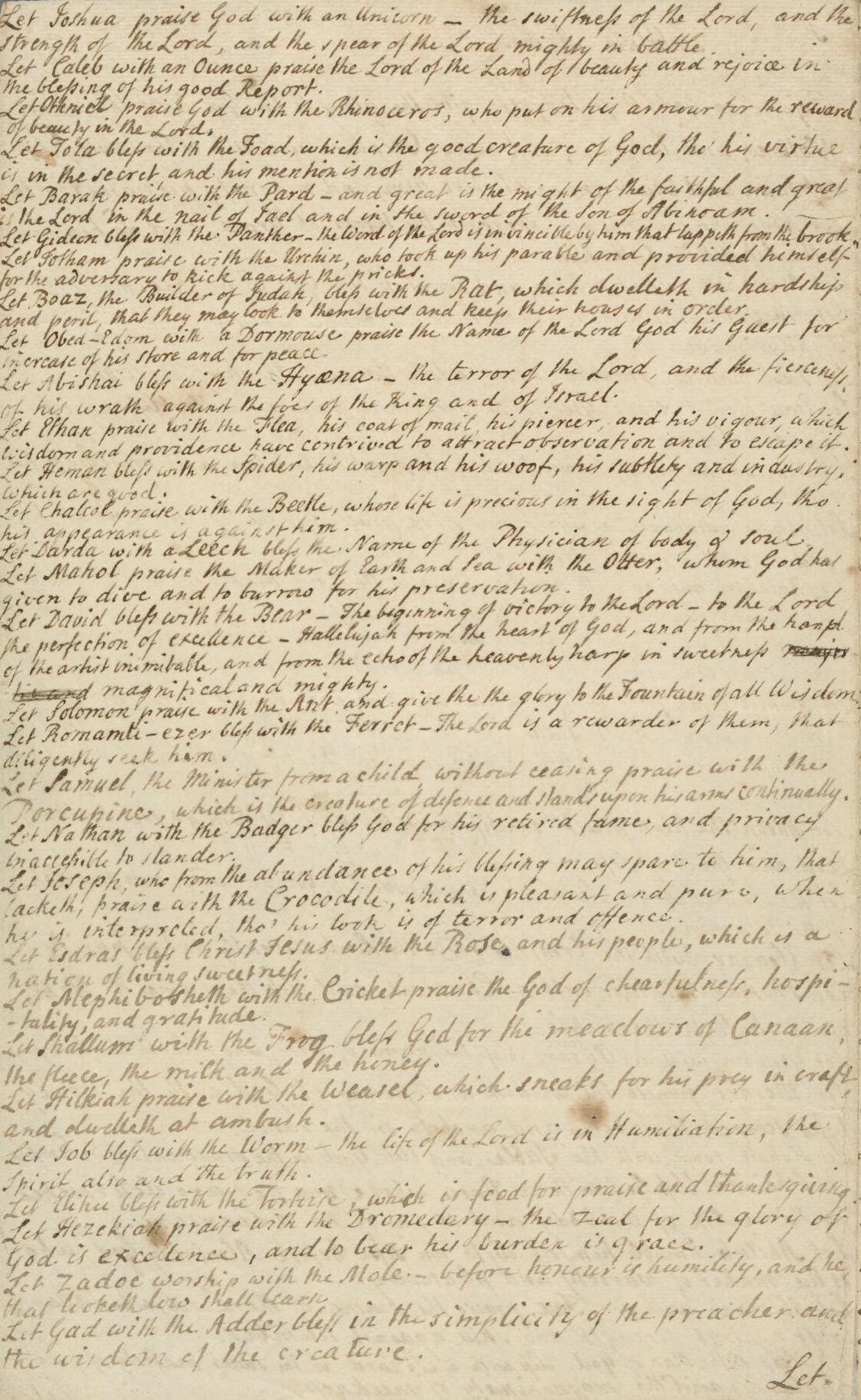
This picture of reality appears most clearly in Jubilate Agno (“Rejoice in the Lamb”), the incomplete poetry manuscript he wrote between 1759 and 1763, during his confinement by his in-laws in insane asylums. Not brought to light till the 20th century, the poem was finally published in 1939 and reordered in 1954 and 1980 editions.
Jubilate Agno consists of four fragments, totaling well over a thousand lines, nearly all of them beginning with the words Let or For. The generally accepted scholarly reading is that Smart intended the poem as antiphonal, the Let verses and For verses meant to be read responsively, Let X / For Y, the way a psalm alternates two voices in worship. The Jeoffry passage is all For lines, because it’s from the side of response (although we lack certainty about the corresponding Let lines). In other words, Smart isn’t just writing free-associative madness. He’s also doing liturgy — the cat’s every motion set into a structure of praise and response, a “duly and daily serving him” devotional order. Jeoffry’s catness is his worship.

The whole poem deserves to be read. Sometimes it’s marvelously comic in its mystical associations of reality and the Bible: “Let the Levites of the Lord take the Beavers of the brook alive into the Ark of the Testimony.” And sometimes it’s heartrending: “For I pray the Lord Jesus that cured the lunatick to be merciful to all my brethren and sisters in these houses,” where the keepers “work on me with their harping-irons, which is a barbarous instrument, because I am more unguarded than others.”
But anthologists since 1939 have settled on the “my Cat Jeoffry” lines (from Fragment B.4) as the representative sample: “For I will consider my Cat Jeoffry. / For he is the servant of the Living God duly and daily serving him.”
And not without reason. The lines are alive — Beat poetry before there were Beats, and the long lines livelier than much of their work:
For he can spraggle upon waggle at the word of command.
For he can jump from an eminence into his master’s bosom.
For he can catch the cork and toss it again.
For he is hated by the hypocrite and miser.
What Smart conveys — better even, I think, than Blake — is the sheer grace of the particularity of the individual creature: wholly itself and yet simultaneously instantiating God’s providential plan. In Today’s Poem, a 58-line extract from Jubilate Agno, we see a joyous Christian mysticism that looks out at the world and sees creation. “I’d as lief pray with Kit Smart as any one else,” said Dr. Johnson.
Me, too.


In “The Late Augustans” Donald Davie included Smart alongside Wordsworth, Cowper, and even Samuel Johnson himself. Though hardly the best period in English poetry, it is richer and more varied than generally recognized. Smart is a good example of that.
What a great poem and such excellent commentary on it! The humor of My Cat Geoffrey is what resonates - I can’t imagine that Christopher Smart didn’t have his tongue in his cheek, chuckling over the mock-solemnity of his verses, all the while driving home the lesson that Mr Bottum points out: creatures may display the glory of God through their idiosyncrasies. I could imagine the “less guarded” Smart taking comfort in the knowledge that he too, glorified God through his own “oddities”.