


(Here at Poems Ancient and Modern we’re taking a Christmas sabbatical, with reprints of our favorite seasonal poems from last year. Our newer readers might have missed these selections the first time around, while our readers of longer duration may enjoy reading them again.)
In the Bleak Midwinter
by Christina Rossetti
In the bleak midwinter,
Frosty wind made moan,
Earth stood hard as iron,
Water like a stone;
Snow had fallen, snow on snow,
Snow on snow,
In the bleak midwinter,
Long ago.

Our God, Heaven cannot hold Him,
Nor earth sustain;
Heaven and earth shall flee away
When He comes to reign.
In the bleak midwinter
A stable place sufficed
The Lord God Almighty —
Jesus Christ.

Enough for Him, whom cherubim
Worship night and day,
A breastful of milk,
And a mangerful of hay;
Enough for Him, whom Angels
Fall down before,
The ox and ass and camel
Which adore.

Angels and archangels
May have gathered there,
Cherubim and seraphim
Thronged the air;
But only His mother,
In her maiden bliss,
Worshipped the beloved
With a kiss.

What can I give Him,
Poor as I am? —
If I were a shepherd,
I would bring a lamb;
If I were a Wise Man,
I would do my part;
Yet what I can I give Him,—
Give my heart.
═══════════════════════
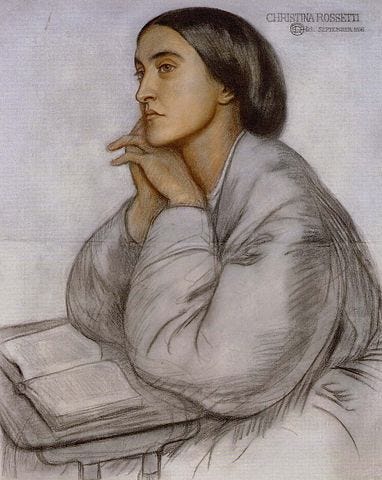
Most of us know this famous poem by Christina Rossetti (1830–1894), first published in Scribner’s Monthly in 1872, as a Christmas carol. Indeed, its original title was simply “A Christmas Carol.” It’s familiar to us in the melody by Gustav Holst, though choral singers may be partial to its treatment by Harold Darke. As seasonal music, “In the Bleak Midwinter” is a sentimental stalwart, its final stanza, especially, seemingly calculated to move an entire Christmas-Eve congregation to weep.
But as tempting as it might be to dismiss Rossetti as a sentimentalist, what she accomplishes in the beautiful language of this poem’s five octaves1 — in predominantly a flexible trimeter2 until the final dimeter line of each stanza, with many lines beginning on stressed syllables, in what I like to call the strong attack — is something far less milquetoast, far more theologically profound, than we might at first imagine.

Significantly, in the first stanza, the poet transposes the Bethlehem stable into the key of the English winter, with its frozen earth and icy ponds. The poem’s opening imagery, however, does more work than simply evoking a bitter Dickensian Christmas scene, from which the coziness of the stable provides a welcome respite. It also does more work than simply pointing to Christ’s universality — though that’s hardly a negligible gesture — or suggesting that the geography of the Incarnation is “England and everywhere” (to misquote T.S. Eliot).
What’s important in this first stanza is that the whole earth is caught in a season of lament. If the ground is “hard as iron,” then the dead are frozen into it, entrapped. Similarly, the water, suggestive of the waters of baptism, is frozen solid, “like a stone.” It resembles nothing more, in fact, than a stone rolled over the entrance to a tomb. Beneath untold strata of snow — emphasized by a stretch into tetrameter in line 5, then in line 6 a drop into dimeter, as though to pile on yet another layer — all creation sleeps the sleep of death.
Commenting when this poem ran last year, our friend and occasional guest contributor Adam Roberts noted that the poem’s color palate, apart from the suggested grayness of the iron imagery, is all white. Even bleak, he remarked, is
a word cognate to blank, blanched, bleached (from Middle English blak, blac “pale, wan”, and Old English blǣc, “pale, pallid”); the white snow is falling, and its fall is reiterated, making the whole world white; in the stable Jesus is fed with white milk and the shepherd brings a white lamb as gift. No other colours are mentioned. We might say that winter is a white kind of season, at least in the higher latitudes of the northern hemisphere—though surely not in the Holy Land—but a carol like ‘The Holly and the Ivy’, invoking the very non-Galilean holly bush, at least brings in the red berries as symbolic of the blood Christ will shed. Not this poem. The whiteness perhaps speaks to purity, holiness, of mother and baby, but I wonder if the colour scheme, or mono-colour scheme, doesn’t leach into all the elements mentioned: as if the angels and archangels, the cherubim and seraphim, become whitened by association, made of glass. Or the segue from stanza one (‘snow had fallen, snow on snow, snow on snow’) to stanza two—‘Our God, Heaven cannot hold Him, nor earth sustain/Heaven and earth shall flee away when He comes to reign’—doesn’t suggest, obliquely, that God is descending to the earth (since Heaven cannot hold him) *as snow*, falling through the air as a cold white particulate purity—which earth cannot ‘sustain’, since nothing grows in winter, and God’s reign suggesting its homonym rain, which is what snow in its frozen way is. In line three3 the word snow is repeated five times; the poem has five stanzas; Christ on the cross suffered five wounds.
Into this winter world descends a new life. As stanza 2 asserts, the bearer of this new life both is and is not yet the God of the Apocalypse, from whom, on the final day, “heaven and earth shall flee away” — another of the poem’s spillages from trimeter into tetrameter, as though to emphasis the actual limitlessness of that God, and the way his final coming “to reign” will break down all boundaries and barriers. He has created “heaven and earth,” and he is neither “held” nor “sustained” by his creation, except as he wills himself to be contained in it and dependent upon it, a newborn child.
In keeping with Adam Roberts’s observations, in the course of the poem that bleak/blank/barren white motif rewrites itself as the whiteness of something else altogether, not frozen but warm, not dead but alive and life-giving. At the same time, that life-giving entity, associated with the stainlessness of everything holy, takes into himself, in his mother’s milk and in his general surroundings, the substance of the iced-in world, which he has come to thaw.
As God, the infant in the manger simultaneously needs everything and nothing. As a human child, his needs are simple, few, and already met — yet he depends on them completely. When the narrative voice shifts into both the present tense and the first person in the last stanza, it is only to highlight the utter sufficiency of this helpless newborn, his absolute need, but also his absolute absence of need. He has nothing, but he wants nothing. Everything that “sustains” him now — his mother’s milk, the warming “mangerful of hay” — is of his own making and provision.
In turn, his human worshipper has nothing to give: no lamb, no Magi’s wisdom. The speaker’s heart instead wants and needs everything embodied in that child. The contraction of the meter in the first lines of the final stanza seems to emphasize this sense of poverty and desire, in which the worshipper, thawed in his presence, desires to give, but has only that desire to offer. Even in utter helplessness, the child is the incarnate image of divine generosity. What he gives to the impoverished human heart is his own generosity, the animating impulse of self-giving.


The version of the poem offered here corresponds to its original printing, but subsequent versions often appear as quatrains of three hexameters and a final pentameter line.
As a reader remarked the other day of Thomas Hardy’s poems in Benjamin Britten’s settings, it’s hard to hear this Rossetti poem other than in the familiar hymn setting, which renders it as common meter, often stressing syllables (such as the “on” of “snow on snow”) that we wouldn’t stress if we simply spoke the poem.
Last year we offered the later arrangement of lines, in which lines 5 and 6 of the original version became the single line 3, “Snow had fallen, snow on snow, snow on snow,” to which Adam Roberts refers.
As you discuss the "whiteness" contained in this poem, I kept being pulled back to one of my favorite essays -- G. K. Chesterton's "A Piece of Chalk" (https://www.chesterton.org/a-piece-of-chalk/). Beginning with a kind of apparent silliness about drawing, he segues into a meditation on the color white which always leaves me with chills at its truthfulness and exhortation. Wish I'd thought of teaching this lovely poem (which also gives me chills) alongside it!
Wonderful thoughts and observations. I hope you’re both having a great Christmas!