

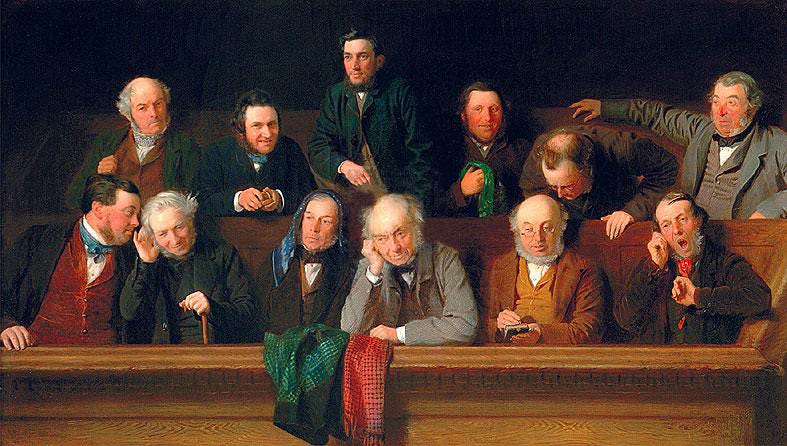

I Read My Sentence Steadily
by Emily Dickinson
I read my sentence steadily,
Reviewed it with my eyes,
To see that I made no mistake
In its extremest clause, —

The date, and manner of the shame;
And then the pious form
That "God have mercy" on the soul
The jury voted him.

I made my soul familiar
With her extremity,
That at the last it should not be
A novel agony,

But she and Death, acquainted,
Meet tranquilly as friends,
Salute and pass without a hint —
And there the matter ends.
═══════════════════════
Again and again, in the nearly eighteen hundred poems she produced in the course of her life, Emily Dickinson (1830–1886) ventures imaginatively into the strange terrain of death, daring, as Julianne Werlin put it recently, “to test the limits of what is thinkable.” Unsatisfied by the formula for Christian hope preached in the First Congregational Church of Amherst, Massachusetts — renounce world/gain heaven — she tilts, repeatedly and relentlessly, at the conventions that, for her, hedge in the vistas of eternal life.
Over and over, she interrogates eternity not only as idea, but as experience. What will it be like, actually and personally, to cross the boundary between the known life of this world, which she loved too much to disregard, and the unknown vastness on the other side? Unsurprisingly, her imaginative pilgrimages into that territory are often lonely. “The carriage held but just ourselves / And Eternity,” ends “Because I Could Not Stop for Death,” perhaps the most enduringly famous of these explorations. “I Felt a Funeral in My Brain,” meanwhile, evokes death as a profound isolation, reflecting at least in part the spiritual and social isolation she felt in her lifelong wrangling with God, a stance that set her apart from those friends and family who had more willingly “renounced the world,” as she repeatedly phrased people’s church-joining in her letters, for the hope of heaven.
Today’s Poem — written in 1862 and first published in the 1891 Poems: Second Series, edited by Thomas Wentworth Higginson and Mabel Loomis Tood — overlaps, in terms of the probable date of its composition, with both “Because I Could Not Stop for Death” and “I Felt a Funeral in My Brain,” though both those poems likely preceded this one. Even if it is the latest of those three poems, in its cold legal presentation of divine judgment, “I Read My Sentence Steadily” reads very much like the first chapter in the same story.


Here is the courtroom, its condemnation made explicit in line 7’s allusion to the judge’s traditional pronouncement of the death sentence: “And may God have mercy on your soul.” From this courtroom we might, with Dickinson, imagine the carriage of “Because I Could Not Stop for Death” as something like a tumbril, carrying the soul, already numbering itself among the dead, past the blithely ignorant living to the place of execution. And “I Felt a Funeral in My Brain,” restored to its original draft, with the breaking of the “Plank of Reason,” ends in something like the hanged man’s final plunge through the platform into darkness and unknowing.
Taken as a sequence, the poems create a terrifying narrative. In this installment, cast in Dickinson’s signature common measure (though with the ballad stanza’s abcb rhyme scheme, and with trimeter in the first lines of stanzas 3 and 4), the God whose mercy is invoked for the condemned soul is the same God whose law has condemned that soul in the first place. What hope can exist in this constricted reality, in which human endeavor, apparently, constitutes sin and “shame,” and God’s justice is confined to the identification and punishment of that shame?
The poem’s speaker, from the first line, steels herself, as it seems, to confront a certain, and certainly awful, doom. Her composure in the face of a merciless God is a central fact of the poem. Strangely, it is by way of this very composure and resolution that the soul outwits the divine judge and slips free of the noose. First, although condemned as a “him” at the end of stanza 2, by the second line of the following stanza the soul has shape-shifted, rather like Virginia Woolf’s Orlando, and become female. Through this pronominal sleight of hand, remaking reality by an act of free will, the soul alters the terms by which the sentence has been pronounced.
Second, and more significantly, under these altered terms the speaker has “made my soul familiar” with the prospect of death. It’s as though, on leaving the courtroom, she sits down with the hangman to discuss the final plan, persuading him to agree that her end not constitute “a novel agony.” Instead of fearing it when it comes, “she and Death, acquainted / Meet tranquilly as friends.” Where in the terrible courtroom death has been presented as an enemy to be feared, and the meeting with death a dreadful punishment in itself, by the poem’s close all terror has been defanged.
This perhaps is the desired effect of Dickinson’s repeated poetic expeditions into the realm of death, and her working-out of its implications. Writing these poems between 1860 and 1862, in whatever order they were initially composed, her project seems to be to make death’s acquaintance, to cultivate its friendship, to develop the consequences of such a friendship, and so to cease to fear it. Ultimately the optimal outcome is that the soul and Death nod cordially as they pass, and “there the matter ends.”


The first two stanzas are so slantedly rhymed (if at all) that it seems as though she didn't really much care whether they rhymed.
The gender switch is very puzzling. "Through this pronominal sleight of hand, remaking reality by an act of free will, the soul alters the terms by which the sentence has been pronounced."
I don't know...that seems a stretch, but I certainly don't have an idea. I don't totally reject the possibility that it's just a bit careless, with an image in her mind of the usually male prisoner being sentenced. Surely she can't have minutely scored every nuance of all those 1800. So many of them (I speak as one whose acquaintance with her work is not deep) have such a dashed-off quality--maybe some of them actually were.
Anyway, I may like this one better than the other two with which you place it.
The Sentence is given to all equally, how can any one person find that unfair?
As a child exits the womb, are they assured of life after birth? Do they fear the
travel down the channel, not knowing what lies ahead?
Perhaps it is only by going to extremes, that one can find a middle way, through
everything, including death.
One might as well meet as friends, anything other, would only cause distress and
there the matter ends.