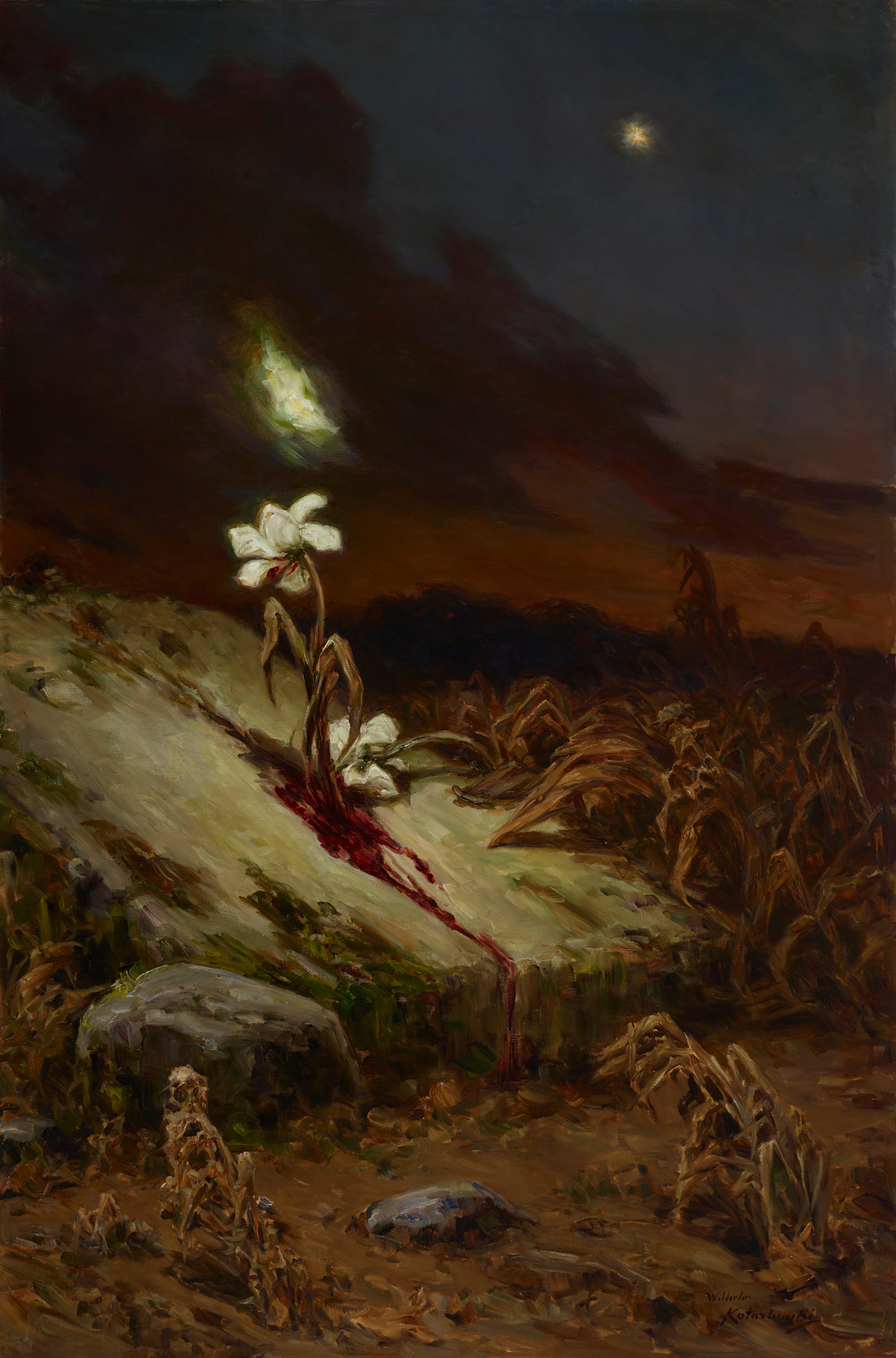
Today’s Poem: Elegy to the Memory of an Unfortunate Lady
The long fun’rals blacken all the way

Elegy to the Memory of an Unfortunate Lady
by Alexander Pope
What beck’ning ghost, along the moon-light shade Invites my steps, and points to yonder glade? ’Tis she! — but why that bleeding bosom gor’d, Why dimly gleams the visionary sword? Oh ever beauteous, ever friendly! tell, Is it, in heav’n, a crime to love too well? To bear too tender, or too firm a heart, To act a lover’s or a Roman’s part? Is there no bright reversion in the sky, For those who greatly think, or bravely die? Why bade ye else, ye pow’rs! her soul aspire Above the vulgar flight of low desire? Ambition first sprung from your blest abodes; The glorious fault of angels and of gods; Thence to their images on earth it flows, And in the breasts of kings and heroes glows. Most souls, ’tis true, but peep out once an age, Dull sullen pris’ners in the body’s cage: Dim lights of life, that burn a length of years Useless, unseen, as lamps in sepulchres; Like eastern kings a lazy state they keep, And close confin’d to their own palace, sleep. From these perhaps (ere nature bade her die) Fate snatch’d her early to the pitying sky. As into air the purer spirits flow, And sep’rate from their kindred dregs below; So flew the soul to its congenial place, Nor left one virtue to redeem her race. But thou, false guardian of a charge too good, Thou, mean deserter of thy brother’s blood! See on these ruby lips the trembling breath, These cheeks now fading at the blast of death: Cold is that breast which warm’d the world before, And those love-darting eyes must roll no more. Thus, if eternal justice rules the ball, Thus shall your wives, and thus your children fall; On all the line a sudden vengeance waits, And frequent hearses shall besiege your gates. There passengers shall stand, and pointing say, (While the long fun’rals blacken all the way) “Lo these were they, whose souls the furies steel’d, And curs’d with hearts unknowing how to yield. Thus unlamented pass the proud away, The gaze of fools, and pageant of a day! So perish all, whose breast ne’er learn’d to glow For others’ good, or melt at others’ woe.” What can atone (oh ever-injur’d shade!) Thy fate unpitied, and thy rites unpaid? No friend’s complaint, no kind domestic tear Pleas’d thy pale ghost, or grac’d thy mournful bier. By foreign hands thy dying eyes were clos’d, By foreign hands thy decent limbs compos’d, By foreign hands thy humble grave adorn’d, By strangers honour’d, and by strangers mourn’d! What though no friends in sable weeds appear, Grieve for an hour, perhaps, then mourn a year, And bear about the mockery of woe To midnight dances, and the public show? What though no weeping loves thy ashes grace, Nor polish’d marble emulate thy face? What though no sacred earth allow thee room, Nor hallow’d dirge be mutter’d o’er thy tomb? Yet shall thy grave with rising flow’rs be drest, And the green turf lie lightly on thy breast: There shall the morn her earliest tears bestow, There the first roses of the year shall blow; While angels with their silver wings o’ershade The ground, now sacred by thy reliques made. So peaceful rests, without a stone, a name, What once had beauty, titles, wealth, and fame. How lov’d, how honour’d once, avails thee not, To whom related, or by whom begot; A heap of dust alone remains of thee, ’Tis all thou art, and all the proud shall be! Poets themselves must fall, like those they sung, Deaf the prais’d ear, and mute the tuneful tongue. Ev’n he, whose soul now melts in mournful lays, Shall shortly want the gen’rous tear he pays; Then from his closing eyes thy form shall part, And the last pang shall tear thee from his heart, Life’s idle business at one gasp be o’er, The Muse forgot, and thou belov’d no more! ═════════════════════════
Whatever hunger is fed by poetry, “Elegy to the Memory of an Unfortunate Lady” should satisfy it — and yet, the poem also feels unsatisfying in certain ways. A 1717 work from Alexander Pope (1688–1744), the elegy contains one of the great curses in English:
Thus, if eternal justice rules the ball,
Thus shall your wives, and thus your children fall;
On all the line a sudden vengeance waits,
And frequent hearses shall besiege your gates
Much energy has been spent on trying to identify the woman on whom the poem is based. After three centuries of scholarship, however, the best guess seems to be that Pope had in mind no particular incident of a woman who was abandoned by her upper-class family and betrayed in love, only to stab herself. He seems rather to have gathered gossip of slightly similar tales to launch an attack on the moral corruption of the wealthy and powerful. His heroic couplets — 82 five-foot iambic lines in pairs of rhymes — allow him to indulge poetic sorrow and anger, and end with the highly stylized poetic observation that when the poet dies, all memory of the unfortunate lady will at last expire. The poem seems more an exploration of a poetic pose than an accurate history.

And yet, the narrative flow of the poem is peculiar, beginning with the “beck’ning ghost” of the first line. Why is she beckoning the poet as she points toward a glade, her gored breast still showing the pale flicker of the blade of her self-slaughter? Why is she there at all, when we’re assured in Stanza 6 that she “peaceful rests”?
The first stanza offers a defense of her suicide, which bothered Samuel Johnson and the rest of the 18th century (a “Roman’s part” a standard literary trope for suicide, as in Shakespeare, when Horatio proposes to follow Hamlet in death: “I am more an antique Roman than a Dane.”) Praise or even acceptance of suicide was immoral enough that even the atheistical David Hume held back his 1755 defense of self-murder, “Of Suicide,” saving it for posthumous publication.
The other serious 18th-century complaint was about the overall argument of the seven stanzas with their irregular number of lines. In the second stanza, Pope disparages those who never aspire to something great, remaining merely “Dull sullen pris’ners in the body’s cage.” And in the short third stanza, he suggests that the woman strove in her suicide for something beyond her ruined state, “sep’rate from their kindred dregs below.” Were that true, however, why the anger of the next stanza — an anger, moreover, not at the man who presumably ruined her (whose existence is suggested by her loving “too well”) but at the uncle who failed to protect her?
And from there we are led to the notion that nature itself mourns at her unsanctified grave (because suicides could not be buried in a churchyard) — and from there to the idea, in the final stanza, that the poet’s fondness is what keeps her memory alive. And when the poet himself dies, she at last will be forgotten.
A coherent argument, this is not. And yet . . . the poem has always been popular, in part because it feels more coherent than it is. We should take seriously that feeling, which Pope achieves, I think, by the poem’s masterwork of parallel construction of clauses. Consider this four-line sentence fragment — in which we get three “foreign hands” constructions, closed off with a pair of “strangers” clauses:
By foreign hands thy dying eyes were clos’d,
By foreign hands thy decent limbs compos’d,
By foreign hands thy humble grave adorn’d,
By strangers honour’d, and by strangers mourn’d!
Or take these lines, where list-making breaks into the parallel to whom / by whom:
So peaceful rests, without a stone, a name,
What once had beauty, titles, wealth, and fame.
How lov’d, how honour’d once, avails thee not,
To whom related, or by whom begot
A light touch and a wry tone are what readers typically remember from the poetry of Alexander Pope: an absurdly talented man from whom words poured out in meter and rhyme as though that were their native essence. And why not? But that makes “Elegy to the Memory of an Unfortunate Lady” among the most un-Popian of Pope’s famous verses. A gift, really, to his readers.


Reading this poem (for the first time), I could not help but think of Rosamund Clifford, the well-known and well-born mistress of King Henry II of England, who was sent away painfully by the king --or it was her idea to leave--some time after 1170 (the year of Becket's murder). Considered the most beautiful woman in England, she resided at the king's lodge at Woodstock for some years, likely known to the queen; but, upon the break-up, she entered the Benedictine house at Godstow near Oxford -- by all accounts a sincere penitent. Rosamund did not kill herself, except that, as a penitent for the rest of her life, she by Grace destroyed a part of herself in order to gain a higher good. It is very revealing that the king was generous to the Benedictine community at Godstow and without shame sent money for a suitable entombment and memorial for Rosamund when she died about 1177. One thing it reveals is the distinct possibility that Henry II was himself penitent, as some chroniclers have it. A cultic devotion to "St. Rosamund" arose at Godstow in relation to Rosamund. It was popular enough that blessed Hugh of Lincoln squelched it. (Oxford was part of the Lincoln jurisdiction in that era.) I am likely far-fetched here; but this is what I imagined could have been an aspect of Pope's inspiration for this strange encomium of a poem.
Would posit a lady, if could remember her name. She was a sincere fan and devoted to Pope. Pope, made the mistake, of thinking, it had a romantic tinge or much more inherent in it. When he proposed an intimate relationship with her, she burst out laughing, the idea was simply preposterous to her. His enmity towards her from then on was venomous and life long lasting.
So would propose, that his proposal and her refusal was equal to her suicide. Which would have left her wretched, alone, unadorned, with no friends to close her eyes, fold her arms, or mark her grave. Just as he had wished might become her, should she move in such a fashion, towards her death. She didn't, but beyond that her name, title, and position is unremembered by me.